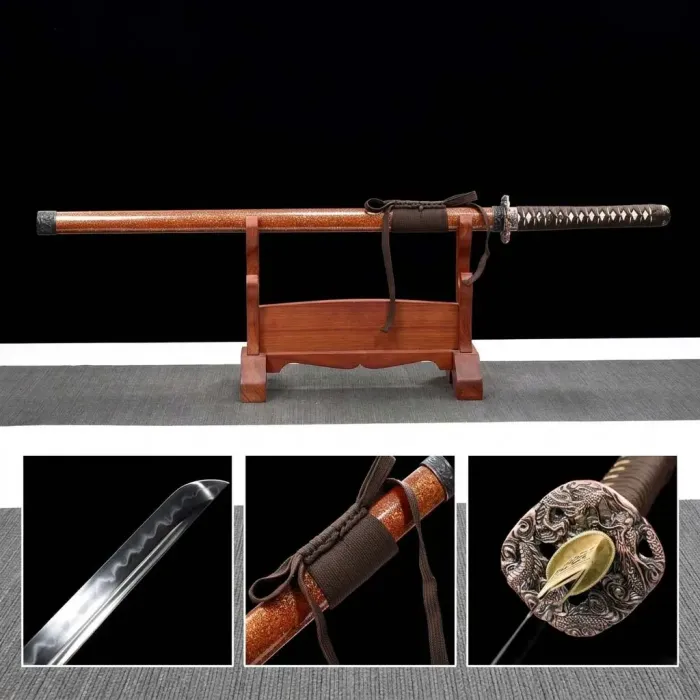
That customary ancient blade exists as a exquisite piece of craftsmanship, but assume you need to manifest your distinct mode? Adapting your tool is a rewarding journey, allowing you to build a truly exceptional piece. From the grasp wrapping and collar to the barrier design and marking, each component offers a chance for specialized modification. This analysis delves into the territory of katana adjustments, providing facts for both newcomers and expert enthusiasts hoping to create their trace on the ancient art of the samurai.
Novice's Verified Handiwork
For learners determined to embark on the exciting journey of historical swordplay, 1060 steel katanas offer an outstanding entry point. This selected grade of carbon steel meets a golden mean between budget-friendliness and quality . While less than hard as elite steels, 1060 accommodates a reasonable level of honing , making it fitting for trainees to improve the fundamentals of katana upkeep and admire the appeal of artisanal Japanese weaponry. It’s a outstanding choice for cultivating experience without the financial burden of more sophisticated steels.
T-10 Steel Edges : Striking Capability and Budget
Enabling enthusiasts seeking an authentic saber experience without crossing the bank , T10 steel katanas represent a promising option. These weapons offer a significant improvement in durability compared to middling alternatives, exhibiting reasonable edge retention and satisfactory flexibility for initial slashing techniques. While not rivaling the eminent characteristics of advanced steels like T100 or folded iron , T10 provides a notable blend of ability and affordability , making them a common choice for apprentices and those on a narrow salary .
Exceeding the Sword : Modifying Your Katana's Attachments and Haft
Despite the sharpened blade is undeniably the important point of a katana, truly boosting its presence lies in the meticulous customization of its features and shaft . This art allows individuals to manifest their one-of-a-kind taste . Assess the extensive possibilities: menuki - decorative charms that introduce visual detail ; the hamon enclosures – often elaborately crafted ; the tsuka essence itself, wrapped in customary ito twine ; and the fusa knob , which can be created from various materials like ingots or antler .
- Adopt concepts that echo with you.
- Explore with different ingredients .
- Prioritize strength for a enduring mark .
The Attraction of the Katana: Legacy, Artistry, and Steelwork
An eastern saber holds a exclusive allure, steeped in phases of the nation's history and folklore . More than merely a weapon of combat , it's a mark of the samurai ethos – a fusion of expertise and command . Its development spanned many generations, with early cutting instruments evolving into the slender curvature and lethal edge we identify today. The production involved is truly remarkable , requiring lifetimes of mentoring to achieve . The process involves a multifaceted folding of steel bloom , creating layers that boost the steel’s flexibility and cutting ability. Multiple schools of blacksmithing appeared , each with their separate secrets and techniques for achieving the ultimate poise and precision - a truly grueling pursuit.
- Original Katana styles
- The task of the katana in warrior culture
- Classic crafting styles
Opting for the Optimal Steel for Your Armament Project: 1060 vs. T10
Choosing the suitable steel is vitally important for any armament project, and the option between 1060 and T10 can be tough. 1060 is a prevalent American fabrication, offering a respectable balance sword custom of robustness and fortitude, enabling it reasonably easy to forge. However, T10, a East Asian steel, frequently boasts increased wear durability and can conceivably achieve a increased conclusive hardness, although it can be considerably demanding to work with and requires precise heat refinement. Consider your qualification and expected benefits: for a rookie, 1060 may be a simpler starting point, while the master smith might choose the improved features of T10.
- Effortlessness of Processing
- Edge
- Maximum Firmness
Unlocking the Potential: Advanced Katana Customization Techniques
Excelling in the craft of sword improvement extends far beyond basic grinding. Serious experts are now exploring advanced techniques to truly release a blade's hidden potential. This requires intricate work with the temper line, utilizing specialized resources for differential strengthening and carefully choosing the outline of the protector to optimize balance and performance. Beyond purely functional customizations, artisans are increasingly focused on producing unparalleled aesthetic splendor, through complex imprinting and layered finishes that truly transform a katana into a fine art.
From Ordinary Steel to Fine Blade: Fabricating a 1060 Katana
The journey commences with plain 1060 iron , a solid material far removed the ornate katana it will change . Talented bladesmiths apply a multifaceted process of combining and fabricating the base steel, repeatedly annealing it and pounding it to clear impurities and create a steady grain structure. This arduous process, often extending for intervals , builds the necessary power and adaptability characteristic of a bona fide Japanese cutlery . Later heat adjustments , including deliberate hardening and tempering , are essential to achieve the targeted balance of sharpness, endurance and loveliness .- Uniting: Removes impurities and develops grain structure.
- Fabricating: Shapes the steel into the initial blade form.
- Annealing: Establishes the final hardness and flexibility.
The Perpetual Attraction of the Katana: Extensive Study of Steel and Alteration
Such long-standing katana remains a striking symbol representing Japanese civilization , its magnetism far outstripping mere weaponry . Forged from a special steel and sometimes featuring intricate motifs , the practice of creation itself is a esteemed art. Beyond the essential craftsmanship, the ability to reshape a katana - from the patterning to the grasp wrapping and habaki - allows for a genuinely individual embodiment for both admirers and carriers alike. This integration of long-established steelwork and boundless personalization produces the katana's continued fame across the earth .
